
Enterprise
Presentation Management Is a Brand Governance Problem (Not a Slide Design Problem)
After 2,500 users and hundreds of conversations with enterprise teams on Google Slides and PowerPoint, the pattern is clear: the deck problem isn't design, it's governance. Here's the four-part breakdown and the architecture we built to fix it.
Mike Cornelius · July 11, 2026 · 7 min read
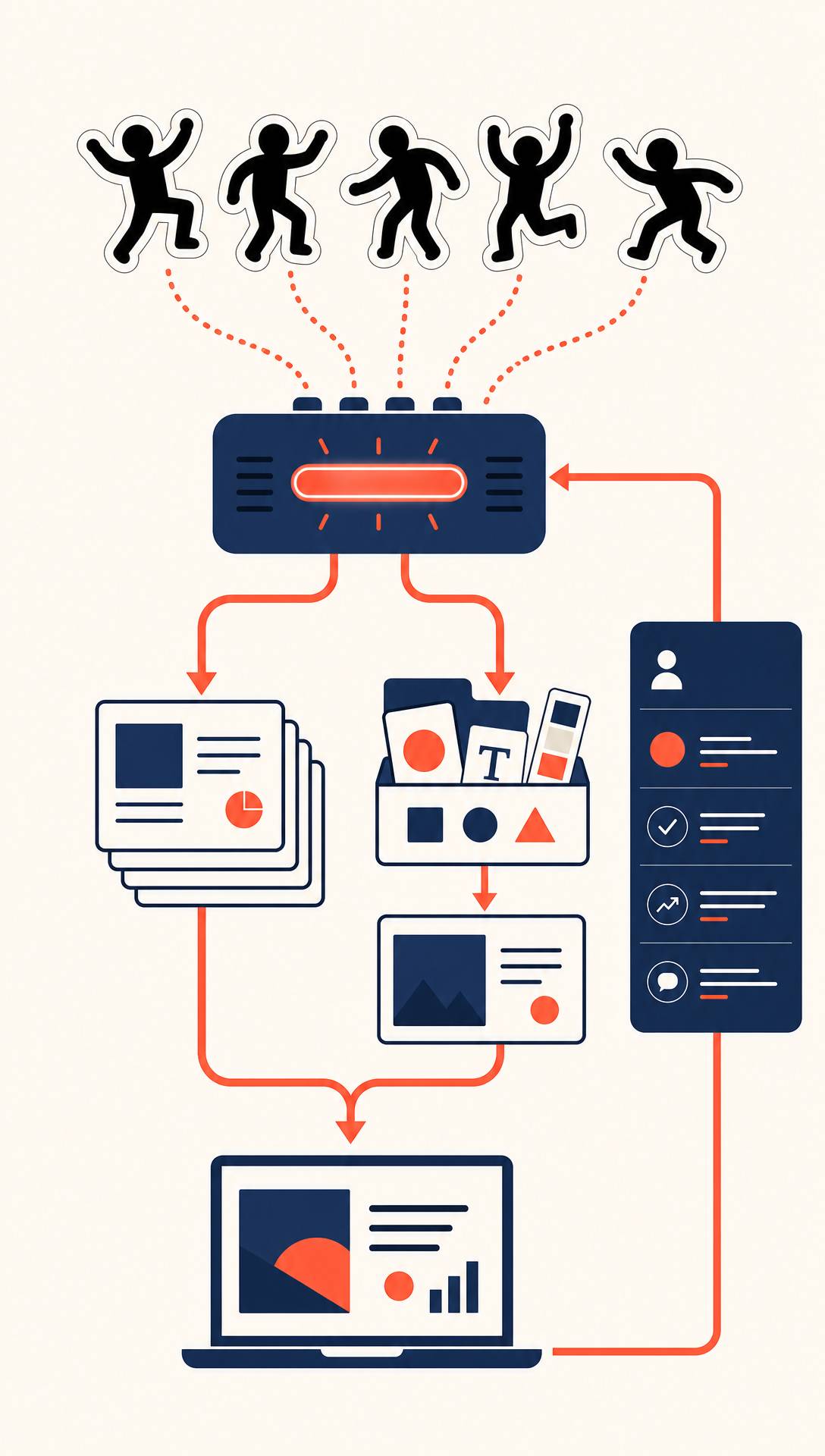
Deck building is an on-fire problem at enterprises right now. We just passed 2,500 users on Decky, and after hundreds of conversations with teams living inside Google Slides and PowerPoint, the same four failures show up over and over.
None of them are design problems. All of them are presentation management and brand governance problems, dressed up in different clothes.
The Four Problems Every Enterprise Deck Team Has
a) Finding the right content and slides. Teams are unhappy with Seismic, SharePoint, and other glorified Google Drive products because finding the right slide becomes a project of its own. Somehow Slack has become the most reliable slide library at most companies: "Hey, does anyone have a deck for XYZ?"
b) Productivity loss from manual customization. Once someone finds the right content, every employee becomes a temporary graphic designer, customizing to varying degrees. Some are great at it. Most aren't. Multiply that across a sales org and you're burning thousands of hours a quarter re-doing layouts that already exist.
c) Zero visibility into what's actually being built. Leadership finds out what shipped only after a customer has already seen it. Whether it's an AI-generated Frankenstein or something thoughtfully crafted, it went out the door with zero visibility from the teams responsible for brand continuity or repeatable processes.
d) Brand degradation from AI slide tools. The current wave of AI slide generators, Gamma, Claude-powered builders, template generators, are color-matching but not using your actual assets, images, or backgrounds. There's a noticeable drop-off in quality between something a human on your team built and something the AI produced. The homogenous, "AI-generated" look is a real barrier to enterprise adoption, or it relegates these tools to internal-only decks because nothing is safe to send to a customer.
Why "Better Slide Design" Doesn't Fix Any of This
Every one of the four problems above is a governance and workflow problem, not a design problem. The slides themselves aren't the bottleneck. The system around the slides is.
- Findability is a slide library problem.
- Customization sprawl is a template and permissions problem.
- Zero visibility is a presentation management problem.
- AI drift is a brand governance problem.
You can hire the best deck designer in the world and still have all four of these issues next quarter. That's why the current generation of "make prettier slides with AI" tools plateaus so quickly inside real enterprises: they optimize for the wrong layer.
The Decky Architecture, in One Picture
We redesigned Decky.ai and built an enterprise option specifically to solve these four failures in one system. The architecture, deliberately oversimplified:
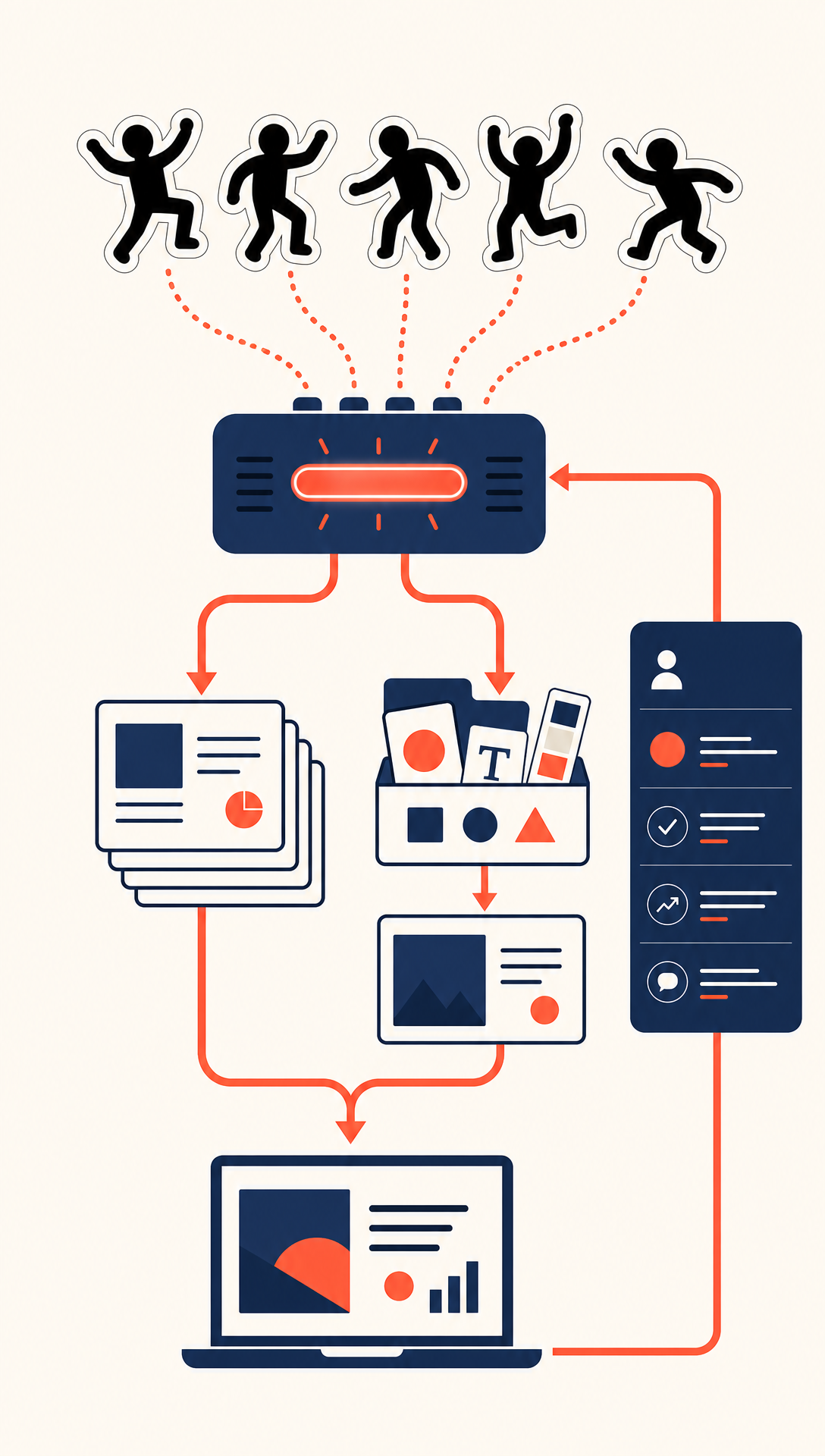
Reading top to bottom:
- Every employee who needs a deck plugs into the same pipeline. No one is building outside the system.
- The generation engine takes a natural-language brief and pulls from two governed inputs: your approved slide library (real slides your team has already built and blessed) and your brand system (fonts, color tokens, logos, image treatments, master layouts).
- The output is a real Google Slides or PowerPoint deck, in the format your team already uses, built from your assets, on your templates.
- Leadership gets visibility through a governance layer that tracks what's being generated, by whom, using which assets, before it ever reaches a customer.
That last arrow, the one going back up to the engine, is the piece almost no AI tool has. Every deck feeds back into what the system knows about your brand, your top-performing content, and what your team actually ships.
What This Fixes, Concretely
- Finding content → the slide library is the input, not an afterthought. If a slide isn't in the library, it isn't in the deck. If a slide is missing, you know exactly what to add.
- Manual customization → the generator handles layout, brand tokens, and asset placement against your master templates. Reps stop being part-time designers.
- Leadership visibility → every generated deck is tracked. Brand, product marketing, and enablement finally know what's going out the door.
- AI brand drift → the model doesn't invent visuals. It composes from your approved library and your brand system. The output looks like your design team made it, because it did, once, and the system enforces it forever.
Why This Matters Now
Every large company we talk to has run at least one AI slide pilot in the last twelve months. Almost none of them made it to standard-issue deployment. Not because the AI wasn't good enough, but because the pilots optimized for a format problem (make a slide fast) when the real problem was a production problem (govern what gets made, from what inputs, and who sees the result).
Enterprises don't need another slide generator. They need presentation management with brand governance built in, running on top of the tools they already use.
That's what we've built. If your team is fighting any of the four problems above, book a demo or read more about how Decky handles on-brand presentations at scale.
Every deck on brand, in minutes.