
Brand
From Brand Guidelines to Living Design Systems
Brand kits used to be flat PDFs. In an AI world where presentations, campaigns, and CMS content are generated by non-designers, brand needs a living design system, executable, observable, and improvable.
Mike Cornelius · July 21, 2026 · 5 min read
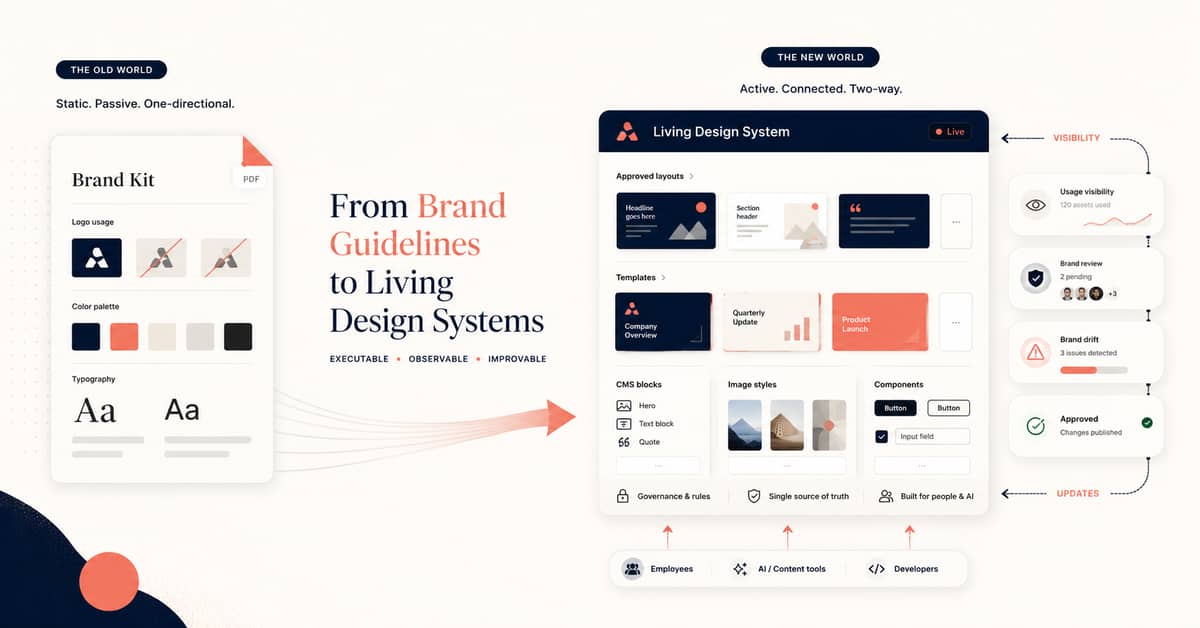
Brand kits used to be flat PDF files listing colors, fonts, and allowed logo usage.
Design systems used to be for building product. That is changing fast. Design systems are increasingly becoming part of generative AI, the substrate that lets a company produce on-brand work without a human designer in the loop for every asset.
Presentations, campaign assets, sales materials, customer stories, and CMS content are increasingly created by people outside the brand and design teams, often with AI. A PDF explaining the brand is no longer enough.
What a living design system actually contains
Companies need a system that can actively apply the brand, not just describe it:
- Approved slide layouts
- Reusable visual components
- Image styles and treatments
- Content patterns and voice rules
- Templates and worked examples
- Explicit rules for what can change, and what cannot
That's the "executable" half. The half most companies still miss is visibility into what is actually being created:
- Which assets are being used, and by whom?
- Where is the brand drifting?
- What should be reviewed?
- Which changes should be approved and folded back into the system?
That feedback loop is the whole point. The strongest systems will not only make it easier to create on-brand work, they will help brand teams see what is happening, review the right things, approve better patterns, and continuously improve how the brand is expressed.
Decks and CMS assets need product-team infrastructure
In other words, decks, campaign assets, and CMS content are beginning to need the same infrastructure that product teams have relied on for years: tokens, components, versioning, usage analytics, and a governance model.
The future of brand governance probably looks less like a static brand book and more like a living design system that employees and AI can actually use.
The companies that make their brand executable, observable, and improvable (not just documented) will have a much easier time scaling it.
Or, the alternative: let 3,000 employees decide what is on-brand or not.
Where Decky fits
This is the exact bet behind Decky's enterprise admin layer: governed slide libraries, reusable components, permissioned templates, and usage visibility, delivered natively inside Google Slides and PowerPoint where teams already work. If your brand rules only live in a PDF today, book a demo and we'll show you what a living design system looks like for presentations.
FAQ
What is brand governance?
Brand governance is the set of rules, tools, and review processes a company uses to make sure every asset produced (internally or by partners, agencies, and AI) stays consistent with its brand. Modern brand governance goes beyond a written policy: it includes governed templates, permissioned component libraries, usage analytics, and an approval loop that feeds real-world learnings back into the system.
How is a living design system different from a brand book?
A brand book is a static PDF describing the brand, colors, fonts, logo rules, tone. A living design system is executable: employees and AI apply the brand through approved layouts, reusable components, and templates, and the brand team gets visibility into what's actually being produced. Brand books document the brand; living design systems apply and improve it.
How do companies automate brand governance across creative assets?
The pattern that works: (1) encode brand rules as reusable components and templates in the tools people already use (Google Slides, PowerPoint, the CMS) instead of a PDF; (2) route generative AI through those components rather than free-form prompts; (3) capture usage data so the brand team can see drift, review the right assets, and promote successful patterns back into the system.
How do you maintain brand consistency at scale across partners, agencies, and AI?
Give every producer (internal, agency, or AI) a permissioned entry point into the same component and template library, so "on-brand" is the default path, not a review checkpoint. Then use usage visibility and lightweight approvals to catch drift early and continuously improve the library. Static guidelines and periodic audits do not scale past a few hundred producers.
Every deck on brand, in minutes.